The raise, one decision at a time
- Decide what the check is a bet on. Known: a current build, a team with shipped titles, no revenue. Not known: whether investor conversations went further on the product or on the people. The early instinct was a detailed walkthrough defending the feature choices already made, and it ran into investors diligencing features that would be obsolete by the next build. I asked whether the current build was the right thing to defend at all. It was not. The pitch moved to the team's record and its iteration cadence, and the build became the demonstration.
- Work the same contacts together. Known: the standard practice is to split the list. Not known: whether splitting produces a stronger or weaker signal on the other end of the call. I asked what the contact actually hears in each case, weighing each opinion by what it cost the person giving it. Two independent reads on one answer, each backed by a visible stake, is a different claim from one introduction. It produced a joint raise off shared contacts, and it changed the unit of work from names covered to conversations that count.
- Build a filter narrow enough to protect two calendars at once. Known: every conversation that did not convert now cost two people's time. Not known: which of the usual qualification questions actually decided whether a conversation should become a pitch. Stated interest, competing deals and paperwork tolerance all mattered once a conversation was under way, and none of them predicted whether it would close. Two questions did. Is there a specific person inside the fund or group who will carry this without either of us in the room, and does their decision process fit a seed timeline. If either answer was no, we did not take the meeting. It produced the filter in the box further on, and it changed our calendar from a list to a queue.
- Write the go-to-market page around the channel, not the ad budget. Known: the summer 2019 materials and a fourth-quarter launch. I asked what had to be true for this game to reach players without buying them. The page that came out of that question is the next section.
- Close the advisory on its own clock. Known: the paid advisory work had a natural end once the seed closed and the launch was behind the company. I asked whether the advisory and the equity position needed to end together. They did not. The advisory closed in September 2020 and I kept my equity position, which is its own signal: an advisor who stays in after the paid work ends believed what he said.
The go-to-market page, read from the summer 2019 plan
The company's plan, in its own terms, was a map game the deck called "Pokemon Go meets Monopoly". Players would buy and hold postal codes on a global map and earn from all activity inside their territory. Every player profile carried a referral code tracked for life. Players would be paid for in-game activity and for referring paying subscribers, and network maps would connect as players joined, so a player earned from the whole web and not only from direct invitations. Revenue would come from monthly subscriptions, a share of micro-transactions for in-game assets, postal-code sales, and a take on an auction and trade marketplace. Influencers were meant to seed the network.
That plan puts the whole go-to-market in one place: the referral engine is the acquisition channel. A game that pays players to recruit replaces a paid-acquisition budget with a payout line, so the question that decides the business is not how much to spend on ads but what a referred paying subscriber is worth over their life against what the payout tree costs to honor. These are the four questions I would put to that page, in order.
| Question | Why it comes first | What a good answer looks like |
|---|---|---|
| Does the game hold a player who is never paid | A game people play only for the payout loses them the day the payout drops | Play first, earning second, in the product and in the pitch |
| What is a referred paying subscriber worth against the payout that brought them | The referral tree is the acquisition budget; it has to be priced like one | A payout schedule set from retention, not from the growth the deck hopes for |
| Who holds the first territories | The first owners are the network's seed; influencers only help if their followers stay | A first cohort chosen for followers who play, not for follower counts |
| One title or several | Every added title splits a small team and a thin launch budget | One title and one launch until retention is proven; the rest waits |
The first question is the one that lasted. The company's flagship today is Prize Kingdoms, and it sells itself as "Play. Win. Earn.", in that order (inkgames.com).
What it produced
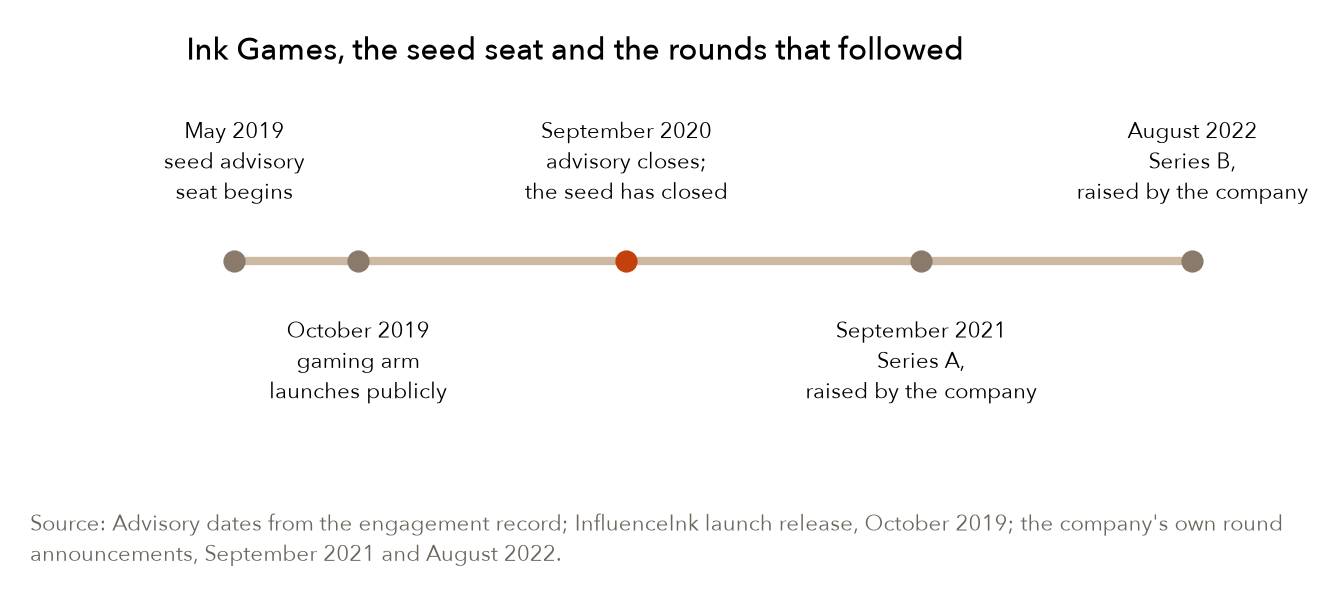
The seed closed in 2020, worked by our capital partner and me off contacts we shared, through Prince Capital. The rounds after it are the company's own work, and I do not claim them. The company raised a Series A in September 2021 and a Series B in August 2022, and a reader can check both dates in its public announcements. It went on to ship Prize Kingdoms and move toward payments.
Two things came out of the seed that I would point to. The first is the kind of backing the company carried into its next round: a joint signal from two named backers who each held a position, not a longer list of individually sourced, unconnected checks. A wide, shallow base and a narrow, vouched one read differently in the next round's diligence. The second is the filter, which outlived the raise.
A later round closing is evidence the company stayed fundable. It is not proof that the story we built in 2019 carried the Series A, and I would not sell it that way. What I can say is what the seed was built to do, and it did it: close a round for a company with no revenue, on the strength of its people, without spending the founder's months on meetings that could never close.
What we kept, replaced and installed
We kept the company's deck and executive summary, the team story on page two, and the referral-led launch plan. They were the right materials; the pitch around them was pointed at the wrong thing.
We replaced two things. The first was the feature-by-feature walkthrough. The company put it in because a team that has built something wants to show it, and because a demo feels like evidence. The fault was the assumption that the build was the asset under diligence. At seed it is not, and a mobile build is always about to change. It had to change in the summer of 2019 because the raise was already live and every meeting spent defending a feature was a meeting that learned nothing about the team.
The second was the divided list. Everyone puts it in, because it looks efficient and it is the right default when a company has revenue or another proof point that stands on its own. The fault here was that it maximized reach when the scarce thing was weight. It had to change before the first meeting, because a list worked twice as fast with half the weight per call is the wrong trade for a company whose only asset is the credibility of the people behind it.
We installed the filter, and it is still how I decide whether to take a raise meeting.
The two-question filter
Ask both questions before any pitch meeting, and take the meeting only on two yeses.
Champion. Is there a named person inside the fund or group who will carry this deal internally without either advisor in the room. A no looks like this: only an associate took the call, and no partner will put their name on it.
Process. Does their decision process fit a seed timeline. A no looks like this: their last seed-stage lead is more than about a year old, or their process is built for checks far larger than a seed round.
Everything else, their stated interest, competing deals, the paperwork they will want, matters after the gate and never decides it.
Two people you trust saying the same thing for the same reason is a different conversation from an introduction. It also costs you half your reach, so every meeting you keep has to be one that can close.
What it cost to hold the line, and what I would watch
It cost reach, every time. Working a list together means half the conversations and two calendars on every one. We gave up contacts we could have reached separately, and some of them might have written checks.
It cost precision about what the filter covers. The two questions test whether a conversation can close. They do not test whether the person across the table is someone you want on the cap table, and they do not test whether either of us should be vouching for this team at all. That second question was answered earlier, at the decision to raise for this company, and the filter never touches it. Calling a closability filter a complete answer to the risk of vouching jointly is the mistake to avoid, and it is the easiest one to make after a structure works once.
It can undersell something truly new. A joint vouch works by two people agreeing on a judgment call, and a product nobody has a comparable for gives two advisors less shared ground to agree from.
What I would watch on any raise where the advisors' credibility is the asset:
- Whether the stakes are visible. Two vouches with nothing behind them read as one friendly introduction. If the contact cannot see what each person has at stake, split the list and move faster.
- Whether the overlap is real. A joint raise only pays when both advisors actually know the same people well. Thin overlap means working weak contacts together, which is the worst of both.
- The upstream question. Before any filter runs, ask whether you would vouch for this team with your name again if the round failed. If the team changes, ask it again.
- The filter's drift. Once meetings start going well, the temptation is to add a third or fourth question. Every question added is a meeting you will talk yourself out of; keep the gate at the two that decide.
The result, in short
The seed closed in 2020, worked jointly off contacts our capital partner and I shared, through Prince Capital. The company went on to raise a Series A in September 2021 and a Series B in August 2022 on its own, and shipped Prize Kingdoms, which sells itself as Play, Win, Earn. I kept the two-question filter afterward and still use it to decide whether a raise meeting can close.
A slice of the project list
A few related projects.
- Drive for the Dream: creator, a golf docuseries venture, signed cast and producers before any platform ask (2023 to 2025)
- Contractor Gorilla: search strategy and an advisor seat with equity in the agency (2014 to 2017)
- Alice Mushrooms: Seed Advisor, Go-to-Market, retail entry into national grocery (2022 to 2026)
- Aycre Capital: fund formation and capital raise process, Managing Director (2022 to 2023)